
What a Portsmouth Deed Can Establish
A recorded deed documents a conveyance Portsmouth accepted into its land records. It names the parties, describes the property, and states the terms of transfer. To use it well, compare the legal description and recording reference against the assessor parcel. Then check the prior deed. Those cross-checks catch errors fast. The local system runs on an index and book structure. What follows describes common deed concepts. It is not a list of Portsmouth portal filters or a sample record row.
| Deed Type | What It Does | Common Use |
|---|---|---|
| Warranty deed | Conveys an interest with promises defined by its terms | Review the warranties in the instrument |
| Quitclaim deed | Transfers whatever interest the grantor has, if any | Often used to change or clarify parties |
| Grant deed | Records a transfer; the exact assurances depend on its text | Read the instrument, not just its label |
| Trustee or executor deed | Shows a transfer by a fiduciary | Pair it with the authority or court file |
| Foreclosure or tax-sale deed | May follow a court or statutory sale process | Confirm the final order and later recording |
A deed and a deed of trust are not the same record. The deed reflects a conveyance. A deed of trust secures an obligation. Later assignments, modifications, or releases may follow it. Seeing a mortgage or lien in an index proves nothing. It says nothing about whether it is still unpaid. Search for the satisfaction or release before concluding anything. Then read the linked court or recorded documents yourself. The full chain tells the story a single index line cannot.
Portsmouth SRA Index Fields Have Known Gaps
Virginia Secure Remote Access is known as SRA or COVERS. It serves as the statewide doorway to local circuit-court land records. The Portsmouth-specific search form is not part of the published access description. The Clerk's letter documents record categories and years. The state's general page explains that a participating clerk may allow free index access. But images may be restricted to authorized subscribers. Treat the field inventory as a map of the documented territory. Live confirmation is still needed for the rest.
| Search control | Research status | What to verify in Portsmouth |
|---|---|---|
| Locality | Portsmouth Circuit Court is the selected court | Choose Portsmouth when enabled |
| Party name and role | Grantor-grantee index is documented | Exact/partial behavior and role selector are not confirmed |
| Document type | Deeds, judgments, financing statements, wills/fiduciaries are listed | Full live dropdown was not captured |
| Date range | Coverage years are in the Clerk's letter | Live date fields and required status are unknown |
| Book/page or parcel | Useful references in the record trail | Search-field support was not confirmed |
Expected fields are not observed fields. If a search fails, try party-name variants and ask the Clerk how its local index handles a date or book reference. The Virginia SRA overview describes the statewide access model, not every Portsmouth-specific control.
Portsmouth Index Years Differ by Record Type
The clerk's remote-access letter gives distinct starting years for its indexes. Deeds and land records begin in 1858. Financing statements start in 1991, judgments in 1984, and wills and fiduciaries in 1996. These are index runs. They are not a promise that every image is online from the first year. Anyone tracing ownership should keep the deed index separate. Keep it apart from the related judgment, probate, or financing-statement search.
The letter is dated 2011. It lists subscription charges from that time, so treat those amounts as historical rather than a current price quote. Confirm current cost and sign-up rules with the Clerk before ordering image access. The state SRA page says image viewing may require an authorized subscription agreement. That requirement applies even where index-only access is free.
Compare the notice with the current statewide access description. Use the Portsmouth deeds and land-records page and the SRA guidance. The court's public remote-access page explains the index and subscriber split.
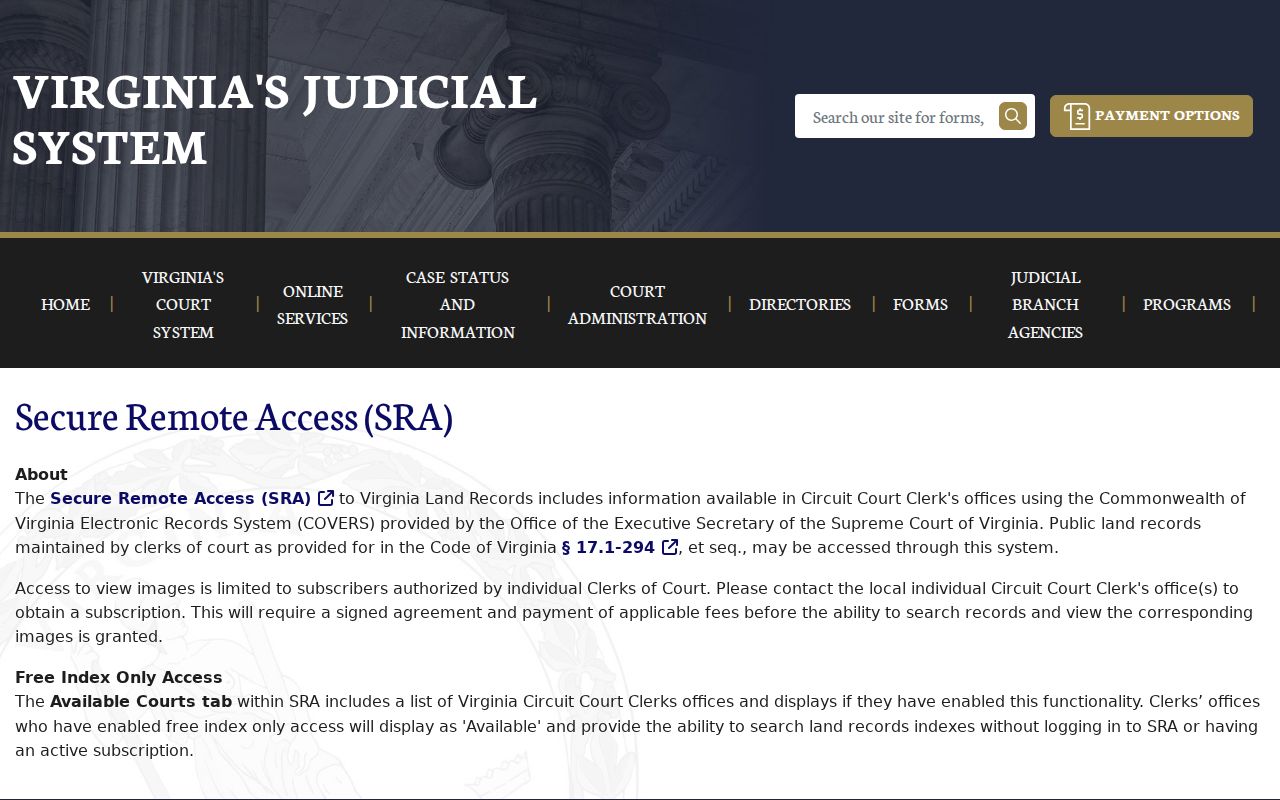
For Portsmouth deed records, start with the statewide access overview, then rely on the Clerk for local terms.
Deed Images and Index Entries Are Separate
An index entry is a pointer, not the full deed. SRA's general rule allows index-only searching. A clerk must enable it. Images sit behind subscription. The clerk's local notice says images attach to some indexes and describes the subscriber credentials. A missing image link does not mean the deed is missing. Ask the Clerk about an in-person terminal or copy request. Bring the names, date, instrument type, and book/page clues from the index. The Virginia land-record login is the remote entry for authorized image access.
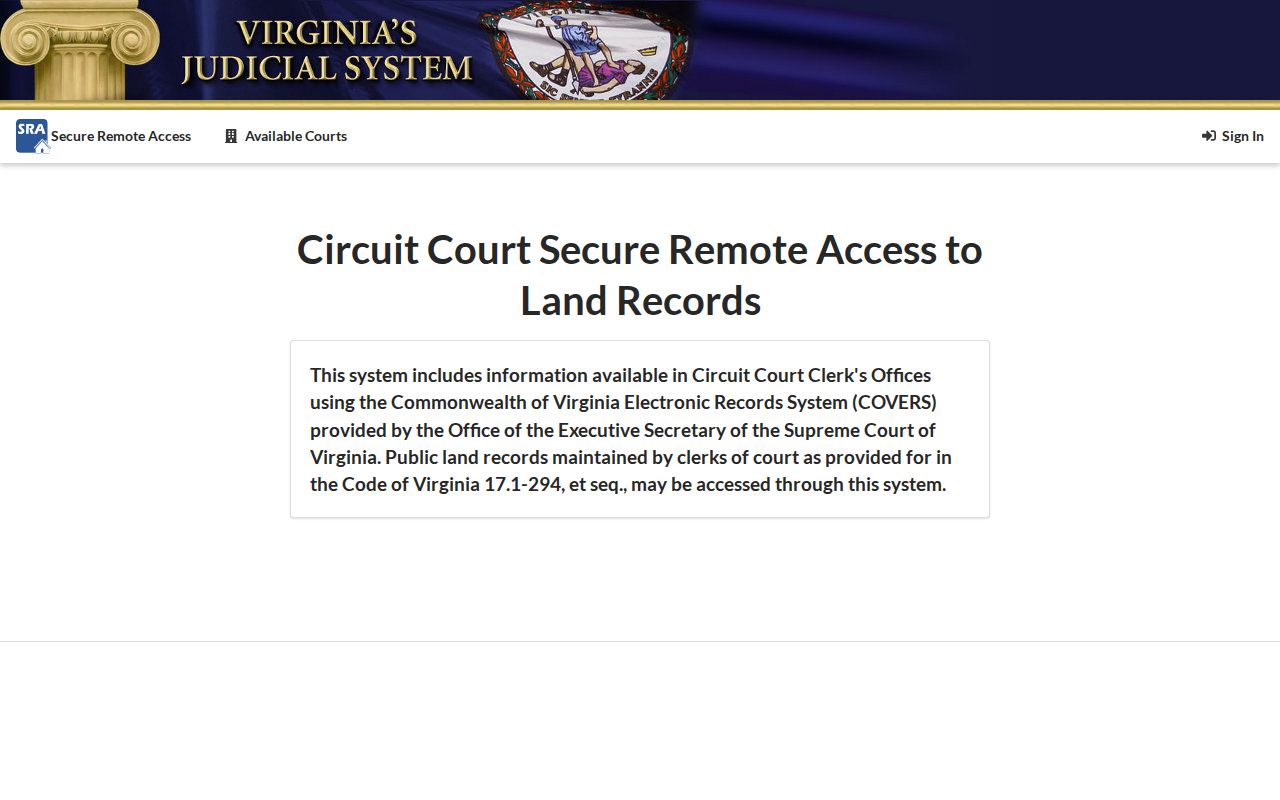
Subscribers should not expect the login screen to display a Portsmouth-specific result. Which deed images you may view is set by the Clerk. Index entries and recorded images are handled on separate terms. That distinction trips up many first-time property search users. The statewide portal covers access generally. The Clerk's office governs what a Portsmouth subscriber can actually open. The Portsmouth Circuit Court Clerk sits at 1345 Court Street, Suite 101. Counter hours are listed as 8:30 a.m. to 4:30 p.m. Call (757) 393-8671 before visiting to confirm access, copy procedures, and current fees. The Portsmouth Circuit Court page lists the office contact details and its online-service links. For the courthouse location and official clerk contact, see the Portsmouth Circuit Court page. Note: A deed-copy letter from a private sender is not a city bill. Verify any request through the official Clerk contact instead of an unsolicited payment link.
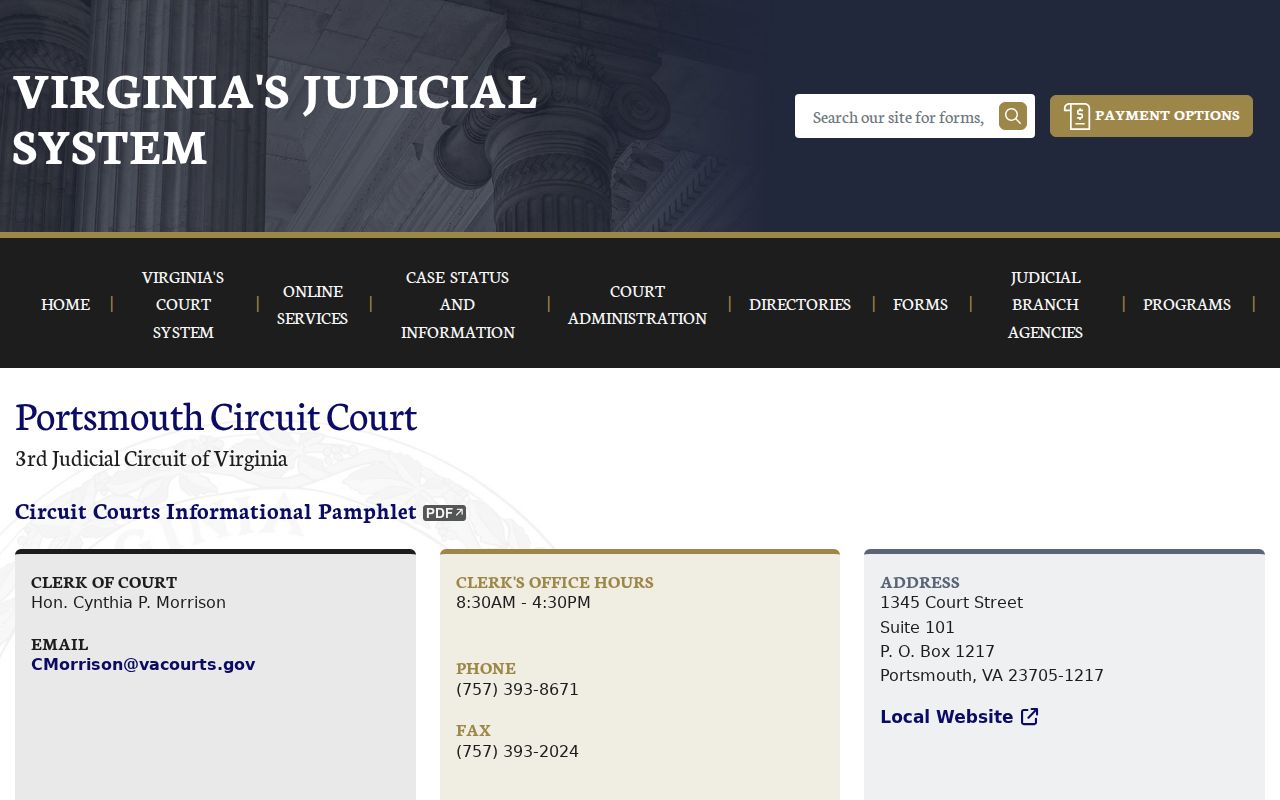
Direct local land-record questions to the clerk's office; the City Assessor and Treasurer keep separate records.
Portsmouth Grantor and Grantee Index Terms
The grantor-grantee index is read by party role. In any deed, the grantee receives the interest and the grantor conveys it. To move backward, start with the current deed. Note its grantor, and search that earlier party as a grantee. The next instrument may reveal the prior grantor. Repeat the climb with the legal description and parcel context in view. That way, a same-name person or a nearby parcel is not mistaken for the subject property.
- Find the latest recorded transfer and note the grantee, grantor, date, and legal description.
- Search the grantor as a grantee to find the deed by which that party acquired the parcel.
- Compare the lot, block, map, or metes-and-bounds text at each step.
- When the online index stops, carry the last book reference to the older books or microfilm.
- Grantor
- The party shown as conveying an interest in an instrument.
- Grantee
- The party shown as receiving an interest in an instrument.
- Chain of title
- The linked sequence of recorded transfers for one parcel.
- Book and page
- A reference to a volume and page in the land-record books.
Portsmouth Books and the 1970 Cutover
Every Portsmouth search eventually hits the 1970 line. Deed Books 1 through 545 carry the years 1858 to 1969. Digital land-record images begin in 1970. The Library of Virginia holds a microfilm copy of all Portsmouth real-estate records through June 1999. The filmed and digital periods overlap for nearly three decades.
Plat Books 1 through 26 run from the earliest volumes to the present. A deed may cite a plat book and page instead of repeating every lot line. Open the recorded plat to decode the lot and block reference. Treat the tax map only as a map. Never use it as a substitute for the instrument itself. For land predating the 1858 Portsmouth run, the Library's catalog includes Town and City of Portsmouth local records from 1796 to 1868. That predecessor collection is not the same as the later deed index.
The Library of Virginia catalog identifies the Portsmouth microfilm collection. Reading-room rules, reel ordering, and reproduction options should be confirmed with the archive itself.
The same archival catalog also routes a search beyond the Clerk's online image run. Start with the local-record reels. That habit saves hours at the counter.
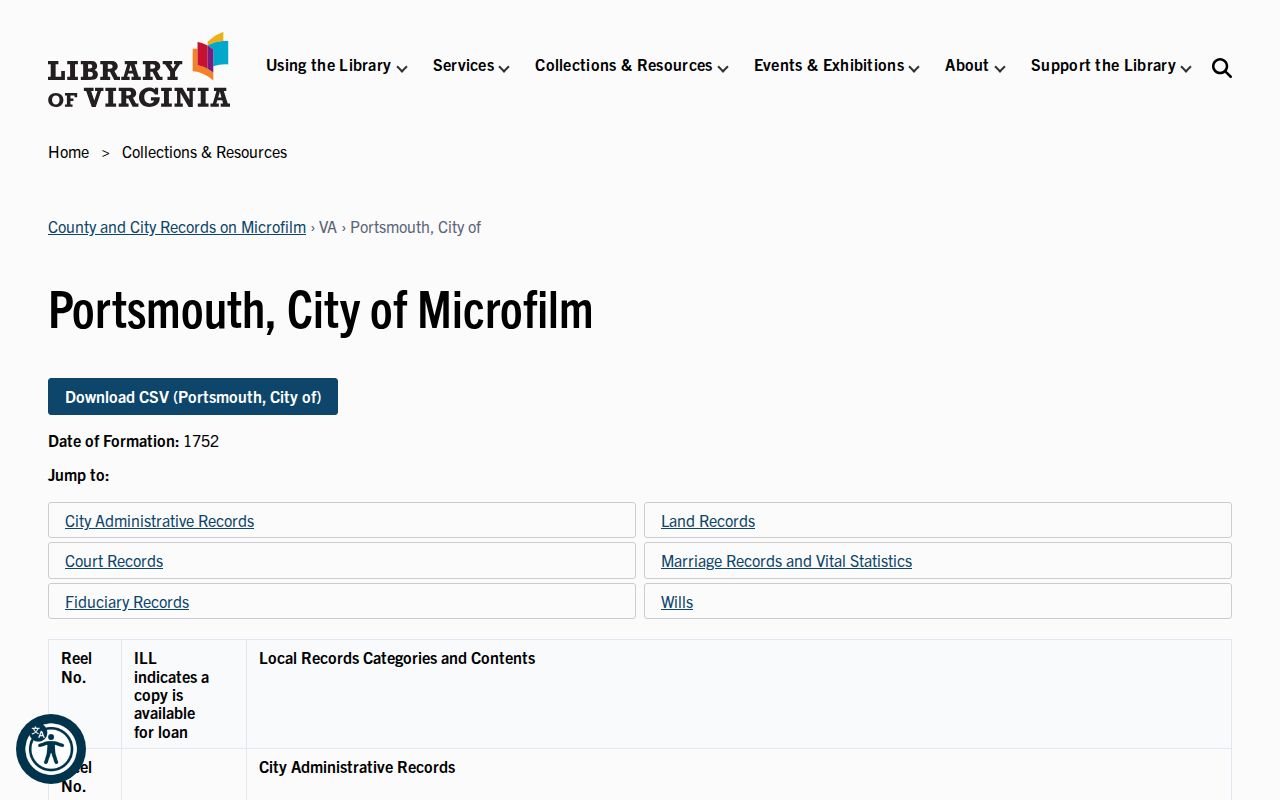
A catalog entry is only a finding aid. Ask the Library which reel serves your parcel and how access works before making the trip.
Portsmouth Recorded Liens Need Later Releases
Deed books rarely tell the whole lien story. Portsmouth land records also hold deeds of trust, assignments, modifications, mechanic's liens, easements, restrictions, rights-of-way, and releases. A recorded mortgage is not a payoff statement. It only proves a lien was once filed. Hunt the later release or satisfaction, and remember that the Clerk's letter separately lists financing statements and judgments, so some encumbrance work reaches beyond the deed index.
Virginia SCC's Clerk's Information System opens a separate route to entity and UCC information. A UCC filing may cover business collateral only. Match the debtor, the property description, and any fixture filing before connecting it to a Portsmouth parcel. It is not an automatic lien. For judgments and pending suits, use the statewide case portal and ask the Clerk for the actual order or recorded document.
A lis pendens or tax-sale notice is a lead. It is not proof of a transfer. Title changes only through the final order, the sale confirmation, and the later deed.
Probate and Court Files Can Explain Transfers
A will can name an heir, an executor, or a beneficiary. By itself it transfers no parcel. Portsmouth's Wills and Fiduciaries index begins in 1996, per the Clerk's letter. Pull the estate file for the will, qualification, inventory, account, and any court-approved sale. Then look for the executor's or administrator's deed in the recorded land records. Chancery and partition files help when heirs compete.
The statewide Case Information System supplies case metadata, not a full image store. Coverage varies by court and case type. Sealed or confidential matters sit outside it. A docket hit proves no conveyance. Request the underlying decree, commissioner's report, sale order, or recorded deed from the right custodian. Compare it with the parcel description.
Federal disputes involving Portsmouth run through the Eastern District of Virginia docket on PACER. Fee schedules and document rules belong to the federal courts, not the local Clerk.
How to Request a Portsmouth Deed Copy
An index hit is just the first step. Ask the Clerk how to pull the image or a paper copy. Remote images may require an authorized SRA subscription. The counter is the fallback for anything unavailable remotely. No current per-page or certification fee is published, so call before sending payment or a mail request. Know your references. Give staff the party names, an approximate recording date, the document type, and the book/page or instrument reference.
State your certified-copy need up front. A screen image or ordinary copy may not satisfy a court, lender, or transaction. The Clerk's older remote-access letter describes subscriptions, but it dates to 2011. Confirm current terms with the official office. When a record hides from the online index, ask whether the counter, a book volume, microfilm, or the Library of Virginia collection is the right next stop.
Recorded, not guaranteed. The Portsmouth deed index shows instruments recorded in the public land-record system. It is not a title opinion, and a complete ownership review may require later releases, court orders, and professional title work.