
Portsmouth's Former-Owner Trail by Era
Portsmouth layers several sources for rebuilding past ownership. The Circuit Court Clerk's deed index reaches back to 1858. Images and older custody follow their own separate paths. A current name search is only the first step. Each deed points to an earlier grantor, while the plat or legal description confirms that both parties dealt with the same piece of land.
| Source | Years It Covers | Where Held | What It Shows |
|---|---|---|---|
| Deed and land-record index | 1858-current | Portsmouth Circuit Court Clerk / SRA | Recorded transfers and references |
| Deed Books 1-545 | 1858-1969 | Clerk, courthouse, and archive path | Older recorded conveyances |
| Microfilm of real-estate records | Through June 1999 | Library of Virginia | Duplicate record images for older years |
| Town and city local records | 1796-1868 catalog run | Library of Virginia | Earlier municipal and predecessor context |
Start with the latest deed and the SRA index. That covers the modern stretch. When an image is missing, the Clerk can point to the counter copy or the book volume. Earlier chains need more. Compare deed books with microfilm before 1970's digital image run, and before the city deed run begins, check the Library catalog for the Portsmouth local records that fit the land's historic location.
Walk the Portsmouth Deed Chain Backward
Former-owner research works the grantee-to-grantor link in reverse. Start at the newest recorded deed for the parcel, not at a familiar family name. Write down the grantor and grantee. Then add the recording reference, date, and property description. Search the prior grantor as a grantee to locate that party's acquisition. A same-name result stays a candidate. Its lot, block, or metes-and-bounds text must fit the same land.
- Find the latest deed that matches the parcel's legal description.
- Record its grantee and the grantor who conveyed the parcel.
- Search that grantor as an earlier grantee and compare the next description.
- Repeat until reaching the index limit, then move to the older book or archive source.
- Grantor
- The party conveying an interest in the deed.
- Grantee
- The party receiving the interest.
- Chain of title
- The sequence of recorded transfers tied to a parcel.
- Legal description
- The land text that helps distinguish one property from another.
Portsmouth's Index Cutoffs Depend on the Record
The Portsmouth Circuit Court Clerk's 2011 remote-access letter lists deeds and land records from 1858 to current. Judgments begin at 1984. Financing statements and wills get separate, newer starting points of 1991 and 1996. These runs answer different questions. A deed chain may need a probate or judgment file to explain why title moved, yet the index for that related record often starts later than the land-record run.
Index and image access differ. A locality may enable free index-only access. Images always require clerk-authorized subscriber access under the current terms. The letter's 2011 subscription amounts are historical. Treat them as no guide to present pricing, and ask the Clerk which route covers the year and instrument you need.
Portsmouth Deed Books Overlap Microfilm
Portsmouth deeds stretch back generations. The city's preservation schedule covers Deed Books 1 through 545, spanning 1858 to 1969. Digital land-record images begin in 1970. A microfilm duplicate of every real-estate record also sits at the Library of Virginia through June 1999. Those overlaps matter. An online scan may be missing. A chain of title may cross the image cutover. Either way, a researcher can carry a book and page reference to the older volume. The archive staff can identify which microfilm reel holds it.
Plat Books 1 through 26 run from the early volumes to current. A plat shows how a neighborhood lot was laid out. The deed records the transfer and the legal description. Neither recorded source replaces the other, so serious title work draws on both.
The Library of Virginia catalog lists the Portsmouth local-record microfilm. The Library's Portsmouth collection page offers a finding aid for historical records.
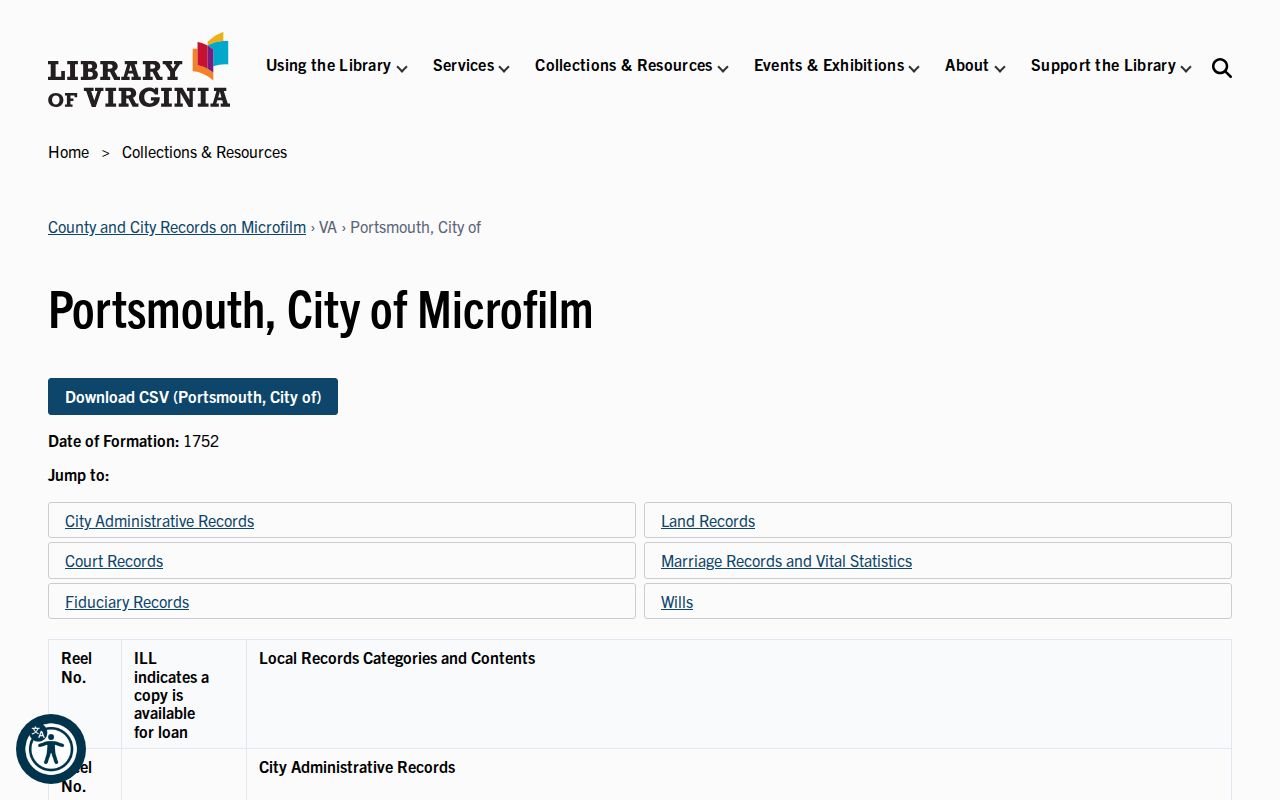
Confirm reel details and current reading-room rules with the Library before ordering or visiting.
Portsmouth Chain Starts With the Latest Deed
Follow the grantee back a deed at a time. Each link lands on the earlier deed that made that party an owner of the parcel. Compare legal descriptions, not just names. Portsmouth's tax key helps locate the current assessment. Older deeds may instead lean on a subdivision lot, plat-book page, or metes-and-bounds call that predates the current map label.
- Start with the newest recorded grantee and copy the full land description.
- Find the grantor named in that deed and search that party as a prior grantee.
- Use the next deed's date and description to check that the same parcel continues.
- When the online result stops, use the book, page, microfilm, or archive reference.
- Grantor / grantee
- The conveying party and receiving party named in an instrument.
- Chain of title
- The linked sequence of earlier transfers for one parcel.
- Legal description
- The land description used to match records across changing addresses.
Portsmouth Directories Help Match an Old Address
The Sargeant Memorial digital collection holds Norfolk and Portsmouth city directories from 1801 through 1931. A reverse street section is included. That section turns a known house number into an occupant lead when the former owner's name is unknown. Directories are usually annual. Some lag or combine years. Gaps appear as well, and a listing may name a business, an occupant, or a household rather than the owner of record.
Use a directory to find a likely name. Then confirm the connection through the deed chain, a probate record, or a city map. Street numbers and names shift over time. Portsmouth also grew through eight annexations from Norfolk County, according to local-history material. No dependable year-by-year annexation map is published, so do not assign a specific date or old boundary from a directory alone.
The digital city-directory collection spans both sections.
The directory archive aids house-history discovery.
Treat any directory entry as a lead only, since the property link itself must come from a deed, a probate record, or a survey.
Portsmouth Probate Files Explain Gaps Between Owners
A clean deed chain can break when an owner dies, an estate is administered, or heirs inherit unequal shares. Portsmouth's wills and fiduciaries index begins in 1996, per the Clerk's letter; earlier material may wait at the courthouse or along the archive path. Pull the probate file. Look there for the will, the qualification, the inventory, any account, and any order approving a sale. Then search the land records for the deed or the distribution instrument that actually moved title.
Chancery books cover partitions, equity suits, and competing-heir disputes. The preservation schedule lists Circuit Court chancery books from September 1858 through August 1999. Husting Court books span October 1866 to June 1973. A will can name a beneficiary. It is not proof the parcel was conveyed. Match the recorded deed or court order to the legal description before crediting any heir with ownership.
Portsmouth Records Before 1858
The 1858 date is a boundary, not a beginning. It marks the deed-book run, not first ownership. The Library of Virginia catalog lists Town and City of Portsmouth local records from 1796 to 1868. Older parcels run deeper. Depending on age and location, earlier evidence may sit in predecessor town or Norfolk County records, patents, or other local files.
Portsmouth is an independent city now. Older deeds do not always use that name. Eight annexations from Norfolk County redrew the map, yet the city publishes no official table of expansion years. Match the deed description and historic map to the present parcel, and avoid naming an annexation year without a source.
Where Portsmouth's Former-Owner Trail Stops
Portsmouth reports no courthouse fire or destroyed deed book. A gap online is not a loss. The known chain can run from remote index to deed book, microfilm, Library of Virginia holdings, or predecessor locality records. Ask the Clerk or the archive. One of those collections may carry the missing year, so check before treating the chain as incomplete.
Lawful use. Portsmouth former-owner research is for house history, title work, and property diligence. Do not use a historic name or address to track, threaten, or harass a living person.